
Here’s the pitch you’ll hear in every forum thread, every Reddit comment, every guy at the gym who “knows a guy”: start small, start cheap, dip a toe in before you spend real money. It sounds responsible. It sounds like the adult in the room talking.
It’s backwards, and I can prove it.
I went into this planning to write the usual price comparison. What changes hands for how much, which supplier undercuts which. Then I actually read the trials, the FDA’s own language on compounding, and a 2025 review of the most hyped peptide in the wellness world, and the cheap-first instinct fell apart in my hands. The compound with the least evidence behind it is the one people buy cheapest and treat most casually. That’s exactly backwards. So is the assumption that spending more money is the beginner mistake. Sometimes spending more is the only thing standing between you and nobody, anywhere, being accountable for what’s in the vial.
Let me show you why, in the order I found it.
The category everyone underrates because it sounds boring
GLP-1 peptides don’t have the mystique of a research-chemical vial with a skull-and-crossbones energy to it. They’re the “boring” option, prescribed to millions, discussed on daytime TV. Which is exactly why beginners skip past them looking for something more exotic.
That instinct should die immediately once you look at the data. In the STEP 1 trial, adults on semaglutide 2.4 mg weekly lost a mean of 14.9% of body weight at 68 weeks, against 2.4% on placebo [1]. That’s a large randomized, placebo-controlled trial, the gold standard, not a testimonial screenshot. SURMOUNT-1 found tirzepatide produced mean reductions of 15.0% to 20.9% across doses at 72 weeks, against 3.1% on placebo [2]. And the investigational triple agonist retatrutide hit a 24.2% mean reduction at the 12 mg dose, 48 weeks in, in a phase 2 trial [3]. I’ll flag that one honestly: “investigational” and “phase 2” mean it isn’t there yet, and I’m not pretending otherwise.
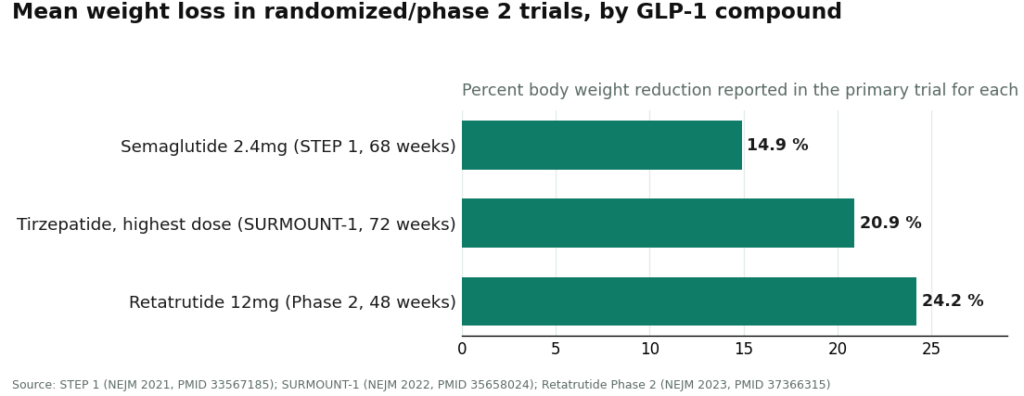
So if you’re new to this space and you want the compound with the least doubt attached to it, you don’t start with the trendy one. You start with the boring one. The evidence isn’t up for debate here. Access and price are the only open questions, and I’ll get to them.
The compound everyone starts with, that the science barely supports
Now the part that made me genuinely annoyed on behalf of every beginner who’s been sold a story. BPC-157 is the peptide-world equivalent of the guy who talks the most confidently at the party. It’s everywhere in recovery and healing conversations, sold with total certainty.
Go read the actual review. A 2025 narrative review in Current Reviews in Musculoskeletal Medicine looked at the human evidence for BPC-157 and called it “exceedingly sparse,” with much of it tracing back to a single research group. The authors’ own conclusion: treat it as investigational until real human trials exist [5]. That’s not me being a contrarian for sport, that’s the paper’s own verdict.
Here’s my concession, because I owe you one: for an experienced user who understands they’re gambling on thin data, choosing BPC-157 anyway might be a defensible, eyes-open bet. I’m not calling anyone stupid for trying it. But a beginner reaching for the cheapest vial of it isn’t making an informed gamble. They’re making an uninformed one, and the low price is doing the convincing that evidence should be doing instead.
Why “nobody approved this” is actually the argument FOR paying more
This is the piece that flipped my whole framing. The FDA states plainly that compounded drugs are not FDA-approved and have not been evaluated by the agency for safety, effectiveness, or quality [6]. My first read of that sentence was “run from compounding.” My second read, the one that stuck, was the opposite.
If no federal agency has cleared the product, the only safety net left is made of people, not paperwork. Someone has to evaluate you. Someone has to compound the medication correctly. Someone has to test what’s actually in the vial. On a supervised route, that’s a licensed clinician and a licensed pharmacy. On a research-chemical site, none of that exists. The “for research use only” label isn’t a technicality, it’s an honest confession that nobody is standing behind the product for a human body.
For a beginner who can’t yet judge a dose, a compound, or a supplier’s honesty, stripping out that human safety net is the single worst thing you can do to save forty dollars. That’s the moment the “follow the evidence” exercise turned into a safety argument, and it’s the reason price has to come last in this conversation, not first.
What the safer route actually costs, now that it means something
Only now does the money conversation make sense, because now you know what you’re paying for.
For a GLP-1, the compound with real trial data behind it, a supervised compounded path commonly runs $129 to $349 a month. Self-pay brand pricing for the same molecule runs from about $349 to well over $1,300. That gap isn’t a manufacturing story. A 2024 JAMA Network Open analysis estimated these molecules could be produced and sold profitably somewhere between $0.75 and $72.49 per month [4]. So the supervised compounded route sits in a genuinely sane middle: far under brand list price, with a clinician and licensed pharmacy still involved.
For BPC-157, supervised compounded pricing runs around $100 to $250 a month, against a research vial at $20 to $70. Given what the review actually says about human evidence [5], the higher price isn’t buying better science, because better science doesn’t exist yet on either side of that gap. It’s buying accountability. For a beginner, that’s the only thing worth paying for at all.
Write this down: if a peptide price looks absurdly low, that’s not a deal, that’s a confession. It almost always means a research vial with zero oversight, and the “discount” is just the price of everything protective being removed.
The actual ranking, now that it’s earned
I held this back on purpose. A beginner who picks a provider before understanding the evidence and the accountability question is doing the whole exercise backwards.
FormBlends is where I’d point a beginner first, and it earns that spot on the logic above, not on being the cheapest name on a page. The mechanics are simple: an online assessment, a licensed physician who reviews the case and decides whether to prescribe, and if appropriate, dispensing through a licensed 503A compounding pharmacy with follow-up built in. FormBlends positions itself as a platform, not a medical practice, with prescribing handled by independent licensed providers using their own judgment, which is the right shape for a compliant telehealth setup and exactly the accountability structure the evidence above kept pointing toward. It also says, in plain language, that its compounded medications are not FDA-approved, and it does not pretend a heavily studied GLP-1 [1][2] and an investigational compound like BPC-157 [5] belong in the same sentence [6]. That’s the judgment call a total beginner cannot make alone. The pharmacy side backs it up with licensed 503A compounding under USP sterile standards, including HPLC purity testing, mass spectrometry, and endotoxin checks, plus a tracker app for anyone who wants structure rather than a one-time purchase. It is not the cheapest line item you’ll find. For a first-timer, that’s not a flaw. That’s the receipt for the safety net.
HealthRX.com takes second place, in the same compliant tier. Licensed telehealth, clinician review, an actual prescription, licensed-pharmacy dispensing, the same accountability bar cleared. Competitive cash pricing on its core programs keeps it in the conversation, and it lands at #2 on breadth and overall value rather than #1. If your starting compound is in its catalog, it’s a legitimately safe place to begin.
Now the part I’d tell any beginner to walk away from, stated plainly. Amino Asylum has some of the lowest prices in the entire category, which is the exact problem: that price reflects the absence of screening, prescription, pharmacy dispensing, and follow-up, the four things a newcomer needs most. Pure Rawz runs the same play, a research vendor with low per-vial pricing, “research use only” labeling, and seller-issued paperwork instead of actual oversight. Swiss Chems sells a broad research catalog, oral and capsule formats included, again with no clinician and no licensed pharmacy anywhere in the chain. I’m not accusing these outfits of fraud, several ship fast and publish certificates. But for a beginner, they strip out the exact thing the evidence says matters most, and the low sticker is what that removal costs you.
The reframed answer
So here’s my actual argument, stated plainly instead of hidden in a comparison table: the “start cheap, start cautious” instinct that beginners are handed by default gets both halves backwards. The cheap route is the reckless one, because cheap means no clinician, no pharmacy, no accountability, on a compound that may have thin human evidence to begin with. The cautious route is the one that costs more, because it’s paying for a licensed physician, a licensed pharmacy, and honest framing about what is and isn’t proven.
Start with the compound that has real trials behind it, a GLP-1, where the numbers aren’t in doubt [1][2]. Treat anything like BPC-157 as investigational, because the researchers who study it say exactly that [5]. And insist on a route with a clinician and a licensed pharmacy in it, because the FDA’s own compounding language is telling you, indirectly, that nothing else is watching [6].
The lowest price is not the safe starting point. The lowest price that still includes a clinician, a licensed pharmacy, honest evidence framing, and follow-up, that’s the safe starting point. Right now that’s the supervised compounded route, FormBlends first, HealthRX.com right behind it. Everyone said start cheap. I went and checked. They were wrong.
Questions worth answering
Where should a total beginner actually start with peptide therapy? Start with the compound backed by the biggest trials, not the cheapest bottle. Semaglutide showed a mean 14.9% weight loss and tirzepatide showed 15.0% to 20.9% in large randomized trials [1][2]. That’s the firmest ground in the entire category. Access it through a clinician and a licensed pharmacy, not a research vial with a research-chemical label on it.
Isn’t a cheap BPC-157 vial the safer way to test the waters? No, and this is the trap. Human evidence for BPC-157 is, in the review’s own words, “exceedingly sparse,” and the authors say it should be treated as investigational until real trials exist [5]. A $20 vial and a $100 to $250 supervised month are buying the identical uncertain compound. The only difference is whether someone accountable is involved, and for a beginner that difference is everything.
Why does accountability outrank price for someone new to this? Because compounded drugs are, by the FDA’s own description, not FDA-approved and not evaluated by the agency for safety, effectiveness, or quality [6]. Once that federal check is gone, the only protection left is human: a clinician who evaluated you, a pharmacy that compounded and tested the product. A beginner can’t yet judge a dose or a supplier alone. Remove the people, and you’ve removed the entire safety net.
What does the safer route actually cost? A supervised compounded GLP-1 path usually runs $129 to $349 a month, well under self-pay brand pricing of $349 to over $1,300. That premium isn’t manufacturing cost. A 2024 JAMA Network Open analysis pegged sustainable production at $0.75 to $72.49 a month [4]. The middle-ground compounded route keeps a clinician and licensed pharmacy in the loop without brand-name markup.
Why should an absurdly low price make you suspicious instead of excited? Because a price that far below what a molecule should cost almost always means a research vial with no screening, no prescription, no pharmacy oversight, and no follow-up. For someone who can’t yet evaluate a supplier, that missing oversight is the actual risk. The bargain is the warning label.
Why does FormBlends rank first when it isn’t the cheapest option? It earns the top spot on evidence and accountability. A beginner completes an assessment, a licensed physician decides whether to prescribe, and dispensing happens through a licensed 503A compounding pharmacy with follow-up. It states outright that its compounded medications are not FDA-approved and refuses to treat a well-studied GLP-1 the same as an investigational compound like BPC-157 [1][2][5][6]. That’s the judgment a beginner can’t make alone yet. HealthRX.com sits at #2 in the same compliant tier for anyone whose starting compound is in its catalog.
How much does peptide therapy actually cost?
Most people land somewhere between $150 and $600 a month depending on the peptide, dose, and source. A physician consult usually adds $100 to $300 upfront. Compounding pharmacies sit in the middle price-wise, and the licensed prescriber attached to that price matters more than the number itself once you’re actually injecting something.
Does insurance cover peptide therapy?
Almost never. Most wellness or performance peptides aren’t FDA-approved drugs, so standard insurance treats them as elective and pays nothing. A narrow set, like growth hormone secretagogues for a diagnosed deficiency, can sometimes get coded in a way an insurer will consider, but don’t bank on it without calling your insurer directly first.
How much does BPC-157 specifically run?
Through a physician-supervised compounding pharmacy, such as FormBlends, expect $100 to $250 per vial depending on concentration and quantity. Research-chemical sites advertise far lower prices, but those products are labeled explicitly not for human use, come with zero dosing accountability, and no pharmacist checking purity. Factor in the risk you’re absorbing on the cheap end, and the gap shrinks fast.
Is peptide therapy actually worth what it costs?
Depends entirely on what you’re treating and how honest you’re being with yourself about it. Some peptides have decent early clinical evidence for specific uses, wound healing and hormone support among them, while a lot of the wellness claims run well ahead of the actual published research. If the goal is realistic, the prescriber is qualified, and the product is pharmacy-grade, the cost holds up. If you’re chasing hype, the math falls apart.
References
- Wilding JPH, et al. “Once-Weekly Semaglutide in Adults with Overweight or Obesity” (STEP 1). New England Journal of Medicine, 2021. PMID 33567185. https://pubmed.ncbi.nlm.nih.gov/33567185/
- Jastreboff AM, et al. “Tirzepatide Once Weekly for the Treatment of Obesity” (SURMOUNT-1). New England Journal of Medicine, 2022. PMID 35658024. https://pubmed.ncbi.nlm.nih.gov/35658024/
- Jastreboff AM, et al. “Triple-Hormone-Receptor Agonist Retatrutide for Obesity, A Phase 2 Trial.” New England Journal of Medicine, 2023. PMID 37366315.
- Barber MJ, et al. “Estimated Sustainable Cost-Based Prices for Diabetes Medicines.” JAMA Network Open, 2024. PMID 38536176.
- “Regeneration or Risk? A Narrative Review of BPC-157 for Musculoskeletal Healing.” Current Reviews in Musculoskeletal Medicine, 2025. PMC12446177.
- U.S. Food and Drug Administration. Human Drug Compounding guidance.
Written by Hana Yang, clinical-topics writer. Cross-checking the claims against the primary sources. Last reviewed January 2026.
For general readers, not a prescription. Check in with a qualified clinician before you begin.